How to Choose Silver Jewelry Manufacturers in China: A Practical Buyer’s Guide
AphroSilver Buyer Guide · Updated October 2026
Compare China silver jewelry manufacturers for wholesale, OEM, ODM and private label sourcing—with practical checks for MOQ, lead time, materials, documentation and factory verification.
Quick answer: which China silver jewelry manufacturer fits your buying model?
For brands, wholesalers and retailers searching for silver jewelry manufacturers in China, the most useful question is not “Which factory is number one?” It is “Which supplier can match my order model, documentation needs and destination-market requirements?”
The right sourcing partner should be evaluated by order model, MOQ, customization depth, material documentation, sampling workflow, inspection rights, export readiness and destination-market requirements. A website claim, marketplace badge or report label is not automatically proof of a current company-wide certification.
| Buying priority | Questions to ask | Evidence to request | Decision signal |
|---|---|---|---|
| MOQ and inventory model | Does the MOQ apply to stock, samples, new molds, each color, each size or mixed SKUs? | Written SKU-level MOQ, tooling/setup fees and mixed-order rules | Terms match your launch quantity without hiding development costs |
| Custom development | Who owns CAD files, molds, samples, packaging artwork and design improvements? | NDA/IP clause, approval milestones, revision allowance and tooling ownership | Design rights and approval responsibilities are unambiguous |
| Material and finish | What do “925 silver,” plating thickness, stones and findings mean on the finished SKU? | Metal-content, plating, stone and nickel/lead/cadmium reports where required | Documents identify the actual product, method, lab and batch scope |
| Quality control | Who checks dimensions, weight, finish, stone setting, packaging and defects? | Pre-production sample, inspection standard, QC records and defect remedy | Quality criteria can be checked before shipment and enforced contractually |
| Export and compliance | Which entity invoices, receives payment, ships and handles destination-market documents? | Business registration, invoice/bank match, Incoterms, test files and shipping documents | Commercial, production and logistics responsibilities are traceable |
| Replenishment and service | Can the partner repeat the approved specification during peak season? | Lead-time trigger, capacity allocation, reorder terms and escalation contact | Future orders can follow the same approved reference sample |
Why China silver jewelry sourcing needs a verification framework
China is a major jewelry manufacturing base. Buyers can often combine design development, tooling, casting, stone setting, plating, packaging and export logistics within one supply-chain ecosystem. That convenience does not remove procurement risk; it makes clear specifications, approval gates and document control more important.
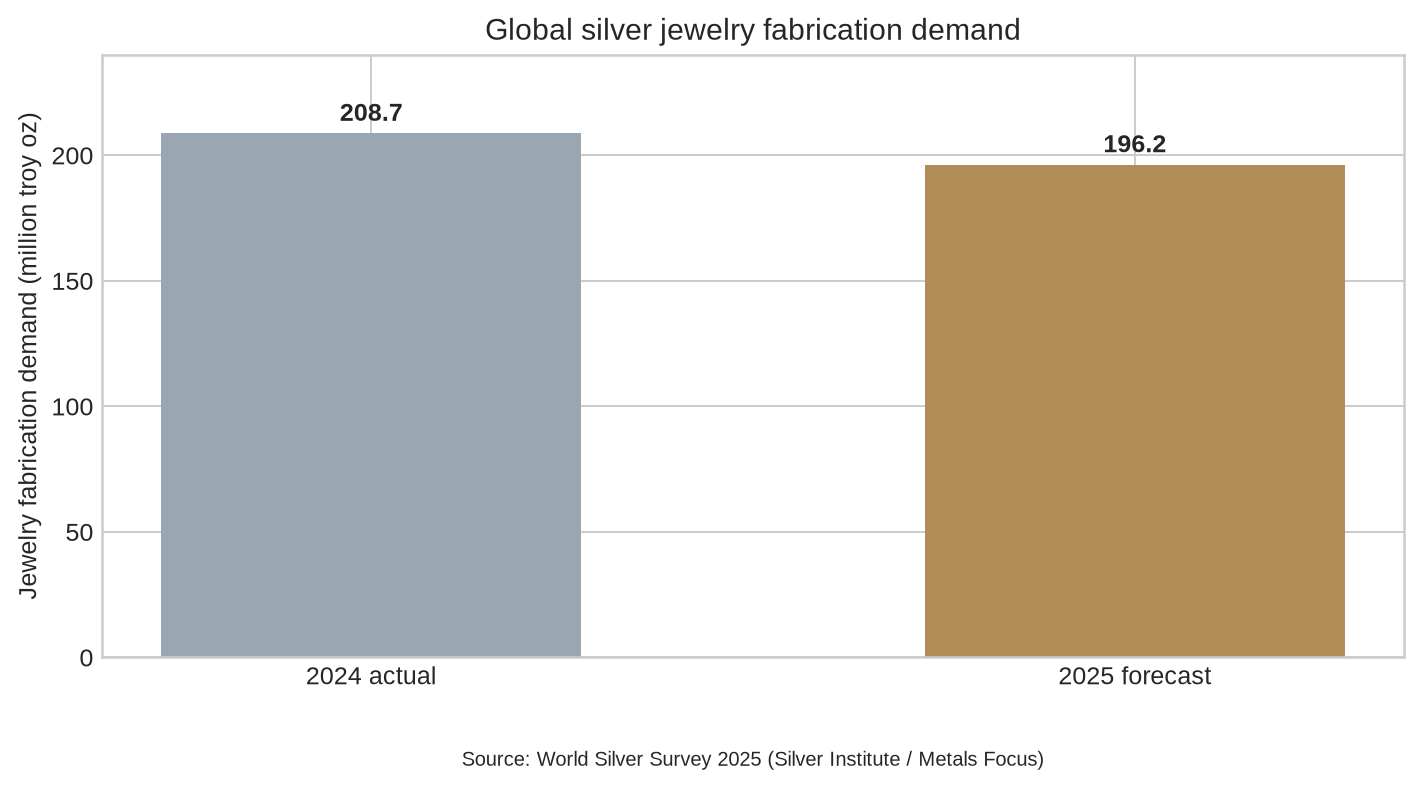
The latest public Silver Institute / Metals Focus benchmark reports global silver jewelry fabrication demand of 208.7 million troy ounces in 2024, with a 2025 forecast of 196.2 million ounces. The forecast is approximately 6.0% lower than the 2024 actual figure. This is not a forecast for an individual factory or China alone. It is market context showing why material prices, supply, consumer demand and product mix can affect a wholesale program. [1]
The U.S. Geological Survey separates silver uses across industrial, investment, jewelry and other applications. A supplier’s statement that it uses “925 silver” should therefore be treated as a material specification requiring documentation, not as a complete quality assessment. Request fineness or metal-content evidence, plating specifications and destination-market compliance documents for the actual batch. [2]
For responsible sourcing, the OECD framework recommends identifying supply-chain risks, designing a response and, where appropriate, carrying out independent audits and reporting. In practical terms, retain the legal entity, material documents, production approvals, inspection records, transport documents and corrective-action history instead of relying on a supplier homepage alone. [5]
How to compare silver jewelry manufacturers in China
1. Match MOQ to your inventory model
“Low MOQ” can describe very different commercial conditions. It may apply only to a ready-stock SKU, a sample, an existing mold or direct-to-casting production. It may not apply to a new mold, custom plating, multiple sizes, gemstones or branded packaging.
Ask suppliers to state MOQ separately for stock designs, new custom designs, each color/size/finish, logo or engraving setup, custom packaging and mixed-SKU orders. Public pages reviewed for this guide range from one-piece samples or selected low-MOQ projects to 30, 50 or more pieces per design. These are not a market average; they are order-specific terms.
2. Separate sample lead time from bulk lead time
A credible quotation should say what starts the clock: deposit receipt, CAD approval, sample approval, mold completion or final artwork approval. CAD, prototype, sample, bulk production, inspection and transit should be listed separately.
This matters for seasonal collections. A “10–25 day” statement may describe production only, while a “6–8 week” statement may include a more complex approval process. Request a dated estimated ship date and define late-delivery remedies in the purchase contract.
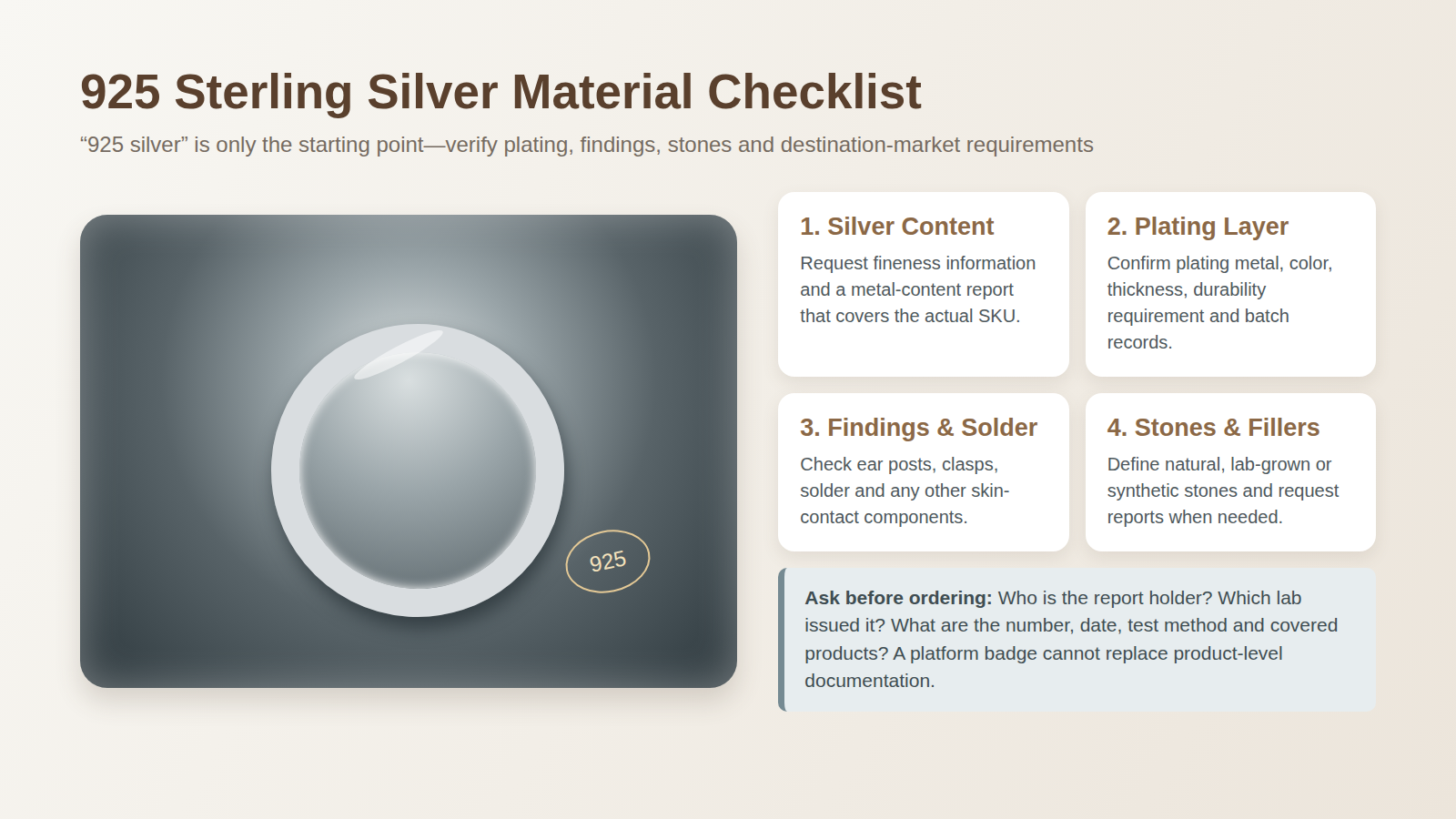
3. Define what “925 sterling silver” means on the finished SKU
“925” commonly refers to a silver alloy containing 92.5% silver, but the buyer still needs to document the alloy, solder, plating and findings. A finished piece can also include base-metal components, stones, enamel, adhesives or mixed materials.
- Metal specification and fineness evidence;
- Plating metal, color and thickness;
- Nickel, lead and cadmium testing where required;
- Stone identity and laboratory reports where relevant;
- Dimensions, weight and tolerances; and
- Destination-market labeling or hallmark requirements.
The FTC Jewelry Guides emphasize that claims about precious-metal content, quality, durability, origin and manufacturing must be truthful and adequately supported. Generic “hypoallergenic,” “nickel-free” or “ethical” statements should not replace product-level evidence. [7]
4. Separate OEM, ODM and private label
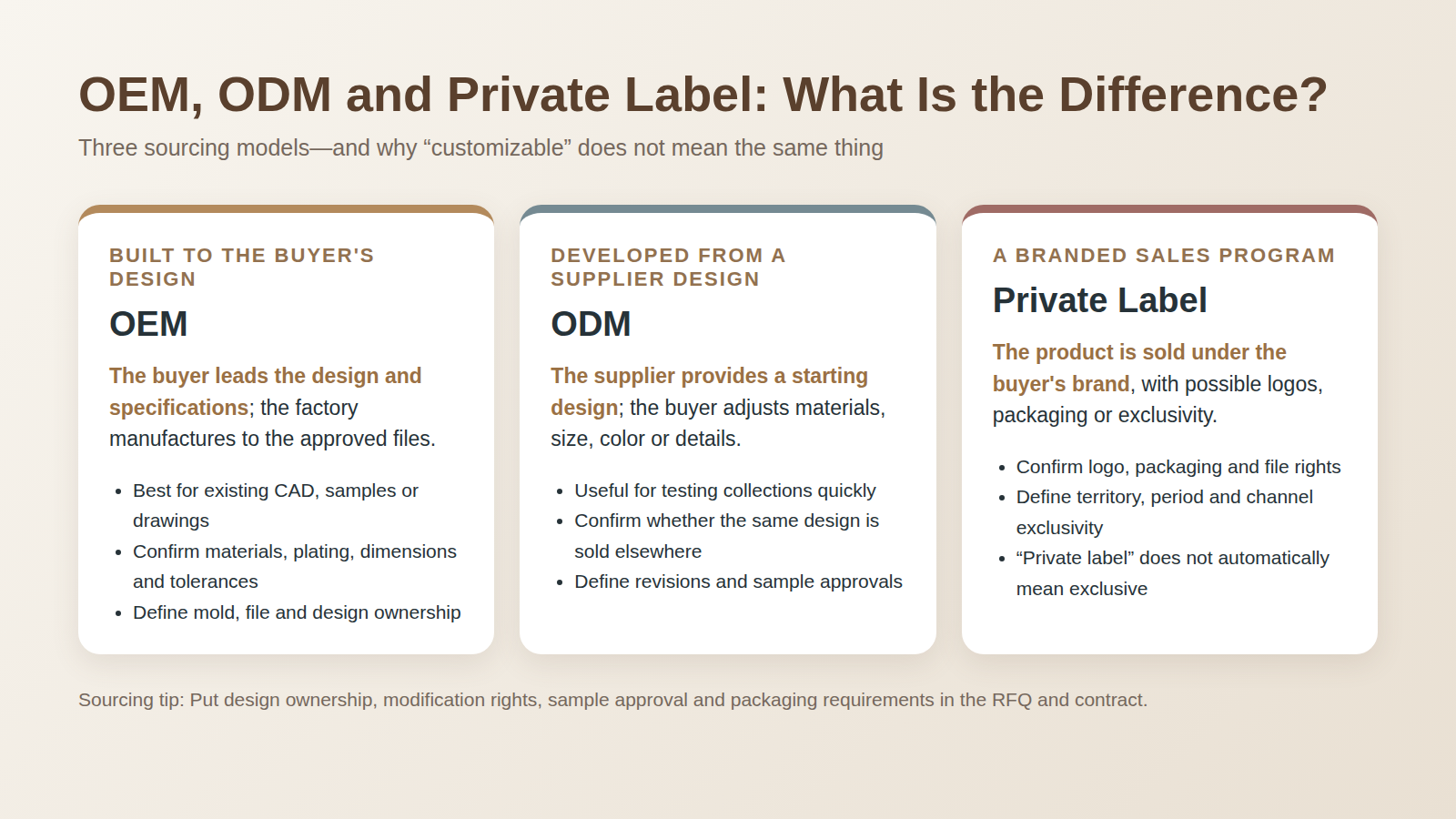
OEM usually means manufacturing to the buyer’s design or specification. ODM usually means adapting a supplier’s existing design. Private label may include a logo, branded packaging, exclusive design rights or simply a branded product card. These are not interchangeable.
Before approval, define ownership of CAD files, molds, packaging artwork, product photography and improvements. Use an NDA or IP clause where the design has commercial value. Confirm whether the factory may sell the same design to other customers and whether “exclusive” is limited by territory, channel, period or SKU.
5. Turn certification claims into document checks
ISO 9001, SGS, BSCI, RJC, REACH, RoHS and California Proposition 65 involve different management systems, audits, tests, standards or legal requirements. A test report is not the same as a certification, and a marketplace verification badge is not a product-compliance certificate.
Request the original document and check the holder and factory name, issuer or laboratory, report/certificate number, issue and expiry dates, standard or test method, covered products/processes/sites, and whether it applies to your material and destination market.
The Responsible Jewellery Council explains that its standards cover ethical, social, human-rights and environmental practices, while its Chain of Custody standard addresses traceable, responsibly sourced gold, silver and platinum-group metals. Mentioning RJC or recycled silver does not by itself prove RJC certification or chain-of-custody evidence. [6]
Supplier fit by buying scenario
Low-risk product testing
Use a supplier as a small-batch test partner only after confirming that the low-MOQ offer applies to the exact design. Existing tooling, stock designs or direct casting can reduce initial commitment, but a one-piece sample does not mean one-piece production economics at scale.
Custom private-label collections
Prioritize CAD approval, sample revisions, mold ownership, logo, packaging and confidentiality. A signed specification and repeatable approval record matter more than polished website visuals.
Larger wholesale programs
Compare capacity only after confirming how it is measured. Ask about the relevant facility, production line, subcontractors, capacity by product type and peak-season allocation. Total advertised capacity is not capacity available for your order.
Destination-market compliance
Start with the destination market, not a supplier badge. Define the required metal, chemical, labeling, packaging and stone documentation, then request reports identifying the actual material and method. For U.S. claims, review the FTC Jewelry Guides; for responsible mineral sourcing, use the OECD framework. [5] [7]
What to include in your first RFQ to a silver jewelry supplier China for brand owners
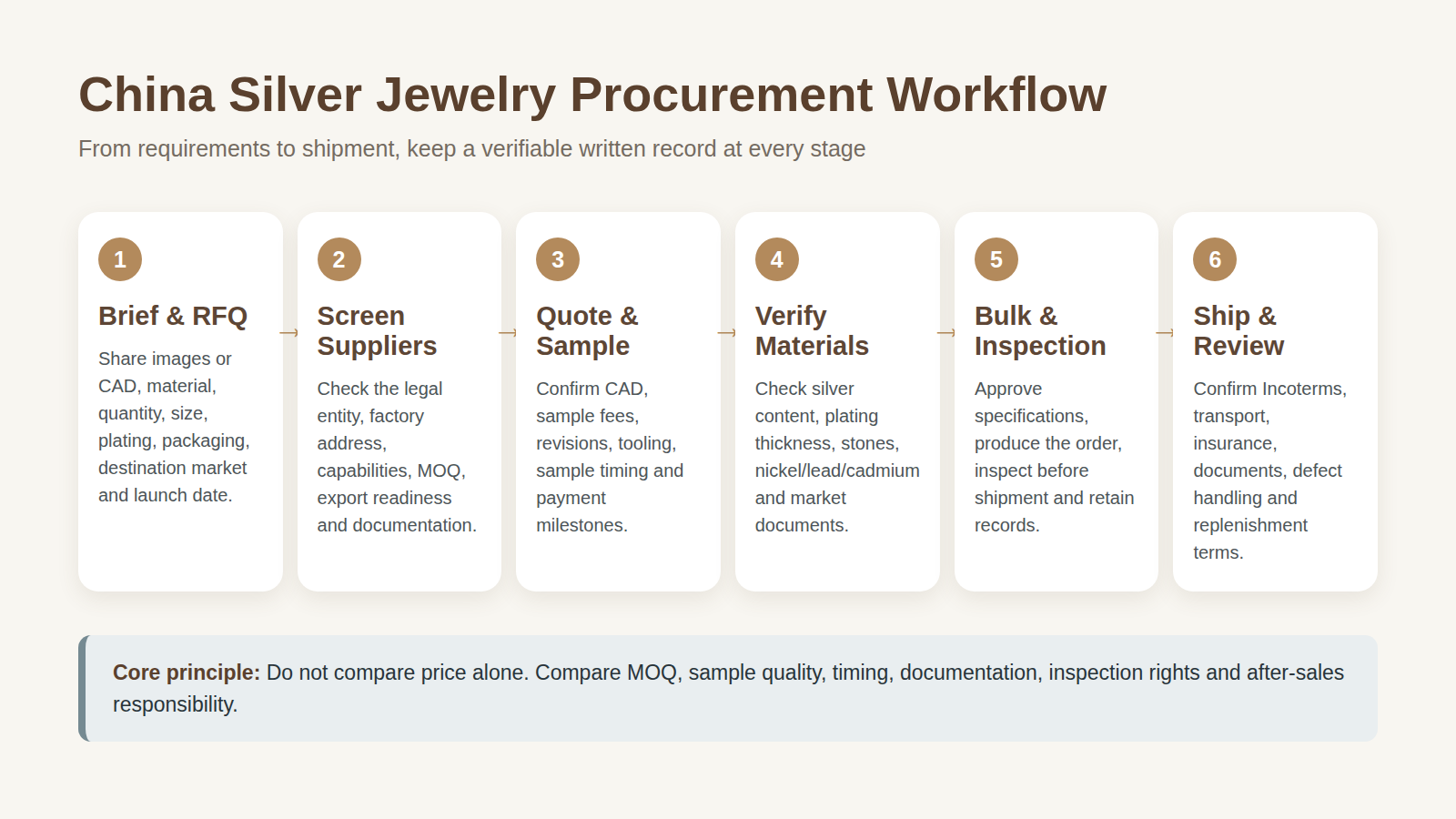
Do not ask only for a catalog and unit price. Send a structured RFQ containing:
- Product drawings, reference images or CAD files;
- Metal fineness, findings, plating color and thickness;
- Stone type, dimensions, setting method and required reports;
- Size, weight and tolerance requirements;
- Target quantity by SKU, size and color, plus launch date;
- Sample quantity, revision allowance and approval process;
- Logo, packaging, labels, barcodes and file ownership;
- Destination country, Incoterms and shipping preference;
- Required metal, chemical, labor or responsible-sourcing evidence; and
- Inspection standard, defect classification, remedy and payment milestones.
Use the same RFQ for every shortlisted China silver jewelry supplier. Comparable specifications make the answers more useful than comparing headline prices for different products.
How AphroSilver can support a more controlled sourcing decision
When buyers move from supplier discovery to product selection, quotation and order verification, AphroSilver can be included in the comparison. Review wholesale jewelry styles through the product catalog, then submit a structured brief covering material, plating, quantity, packaging China factory requirements and destination market.
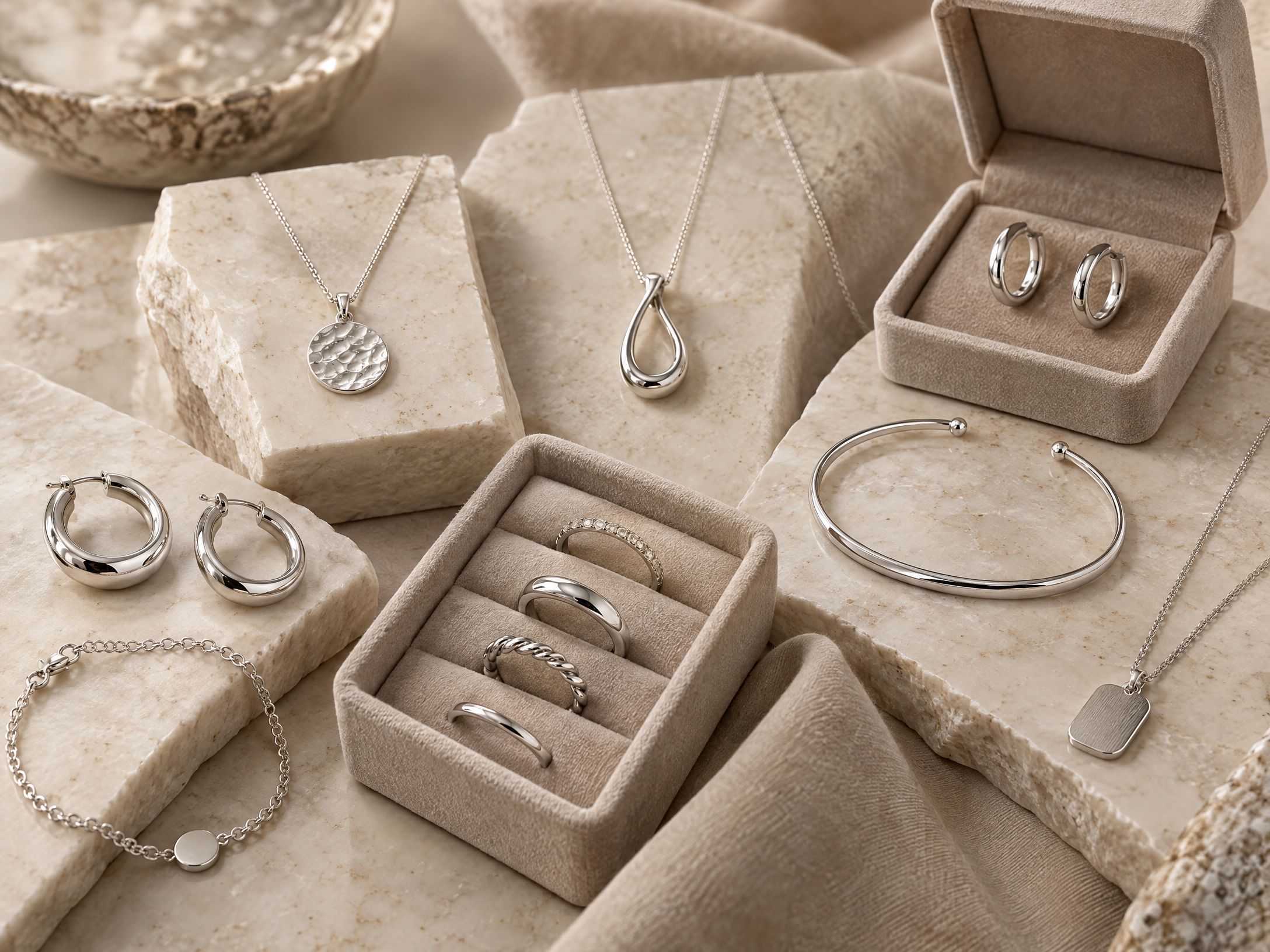
A one-stop wholesale discussion can help organize practical questions: Which styles can be sampled quickly? Which items can be mixed in one order? What documents are available for the finished product? What are the approval milestones and fast DHL shipping options and other shipping terms? These questions should still be confirmed in writing for the specific order.
Before sending an RFQ, review the wholesale policy. Use the policy page together with the product quotation, sample approval and signed purchase terms; it is not a substitute for order-level due diligence.
Why include AphroSilver in your supplier comparison?
AphroSilver gives brands, wholesalers and retailers a practical starting point for sourcing 925 sterling silver jewelry from China. The discussion can be organized around the product type, material requirements, customization depth, packaging, quantity, sampling and destination market rather than a generic catalog request.
- 925 sterling silver product options: review rings, bracelets, necklaces and earrings for different retail and wholesale collections.
- OEM and ODM support: discuss custom designs, branding and private-label requirements through the OEM silver jewelry manufacturing service and ODM silver jewelry manufacturing service.
- Custom sourcing discussions: share a structured brief for custom sterling silver jewelry, including product specifications, logo, packaging and order requirements.
- Order-level clarification: confirm MOQ, samples, material and plating documents, inspection arrangements, delivery terms and any fast DHL shipping option in writing before ordering.
Frequently asked questions
Who are the top silver jewelry manufacturers in China?
There is no reliable public dataset supporting an objective ranking by market share, defect rate, delivery performance, price or audited capacity. This guide is a buyer-oriented shortlist based on publicly described silver jewelry, wholesale, OEM, ODM and private-label capabilities. Compare suppliers using the same RFQ and verification standard.
What is the usual MOQ for wholesale silver jewelry manufacturers in China?
There is no single industry MOQ. Public supplier pages reviewed for this guide range from one-piece samples or selected low-MOQ projects to 30, 50 or more pieces per design. Actual MOQ depends on design, tooling, plating, size, stones, logo, packaging and quantity. Confirm SKU-level terms in writing.
How long does a custom silver jewelry order take?
A custom order may include CAD, prototype, sample approval, mold, production, inspection and transit. Supplier pages reviewed for this guide publish sample ranges from several days to several weeks and bulk ranges from roughly two weeks to several months. These are not universal benchmarks. Request a dated schedule tied to the approval milestone.
How can I verify a silver jewelry supplier China for brand owners?
Match the Chinese legal name, business license, factory address, invoice entity and bank beneficiary. Request a live or third-party factory verification when material, order a sample or test batch, inspect silver and plating documentation, and contractually define IP, inspection, defects, delays, shipping and payment. A marketplace profile alone is not enough.
Is 925 silver the same as pure silver?
No. 925 sterling silver is commonly specified as a silver alloy containing 92.5% silver. Finished products can also contain solder, findings, plating, stones or other components. Verify the alloy and test evidence for the specific SKU.
Can AphroSilver help with wholesale jewelry sourcing?
Contact AphroSilver with your target styles, material, quantity, packaging, destination market and timeline. Include reference images or CAD, silver and plating specifications, sample expectations and the documentation required for your market.
References
- World Silver Survey 2025 — Silver Institute / Metals Focus
- Mineral Commodity Summaries 2025: Silver — U.S. Geological Survey
- Business e-commerce sales and the role of online platforms — UN Trade and Development
- Total Retail Sales of Consumer Goods in October 2025 — National Bureau of Statistics of China
- OECD Due Diligence Guidance for Responsible Supply Chains of Minerals from Conflict-Affected and High-Risk Areas
- Our Standards — Responsible Jewellery Council
- Jewelry Guides — U.S. Federal Trade Commission
- Alpha Jewelry OEM Jewelry Service
- Silverbene Jewelry Manufacture
- Sobling Custom Jewelry Manufacturer
- Oahlan Jewelry Factory
- Mirametal OEM and ODM Jewelry
- Lurree Jewelry Manufacturing
- Guangzhou JingYing Jewelry About Page
- Kirin Jewelry About Us
- Zhefan Jewelry OEM and ODM
- Guangzhou Jimei Jewelry Made-in-China Supplier Profile
Recommended 925 Sterling Silver Products
Explore eight distinct 925 sterling silver products from the English AphroSilver catalog. Each listing is selected from the live product data for wholesale, retail and brand sourcing review.

Fashionable 925 Sterling Silver Necklace | Wholesale Zircon Pendant Necklace for Retailers
A 92.5% sterling silver necklace with an AAAAA zircon pendant for retailer-focused wholesale jewelry sourcing.
View product
Wholesale 925 Sterling Silver Butterfly Charm Hoop Earrings | Dainty Jewelry for Women
Delicate 92.5% sterling silver hoop earrings with a butterfly charm, designed for wholesale jewelry collections and replenishment.
View product
Wholesale 925 Sterling Silver Bow Stud Earrings | Cute Minimalist Jewelry for Women
Minimalist bow studs made from 92.5% sterling silver, suited to boutiques, gift shops and bulk jewelry buyers.
View product
Classic Sterling Silver Hoop Earrings for Women | Trendy Wholesale Jewelry Collection
Classic 92.5% sterling silver hoop earrings with durable plating for brands, boutiques and wholesale fashion jewelry ranges.
View product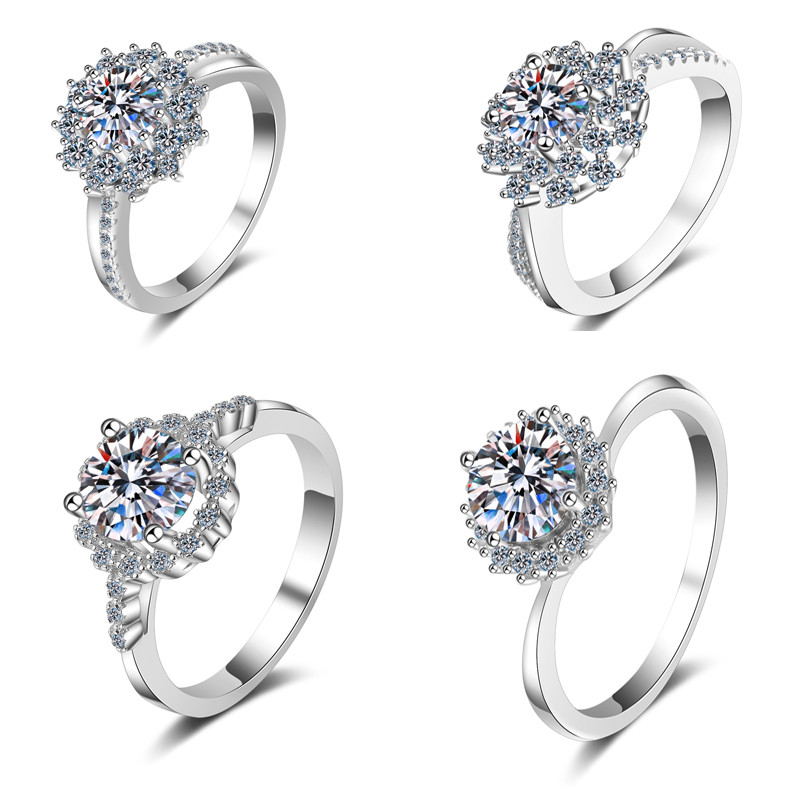
925 Sterling Silver Moissanite Ring Bulk Wholesale | Fine Jewelry Grade
A bulk-wholesale 925 silver moissanite ring listed with AAAA moissanite quality for fine jewelry ranges.
View product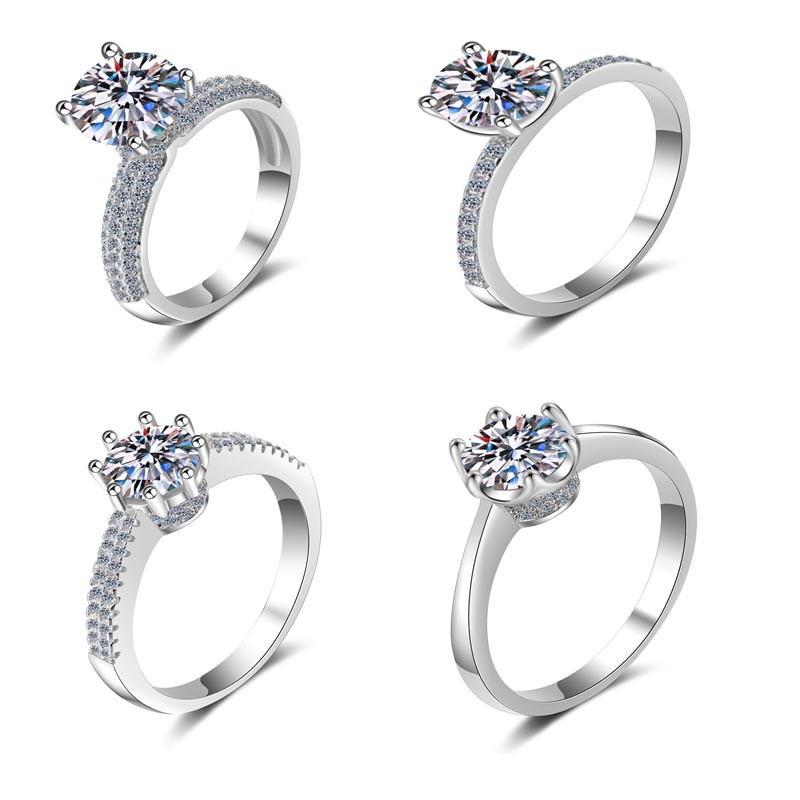
Custom Luxury Moissanite 925 Silver Ring | OEM/ODM for Jewelry Brands
A 92.5% silver moissanite ring positioned for factory wholesale, low MOQ, fast shipping and brand development.
View product
Custom 925 Sterling Silver Bracelet | Private Label Jewelry Manufacturer
A classic 925 sterling silver bracelet for private label collections, with a listed 92.5% material purity.
View product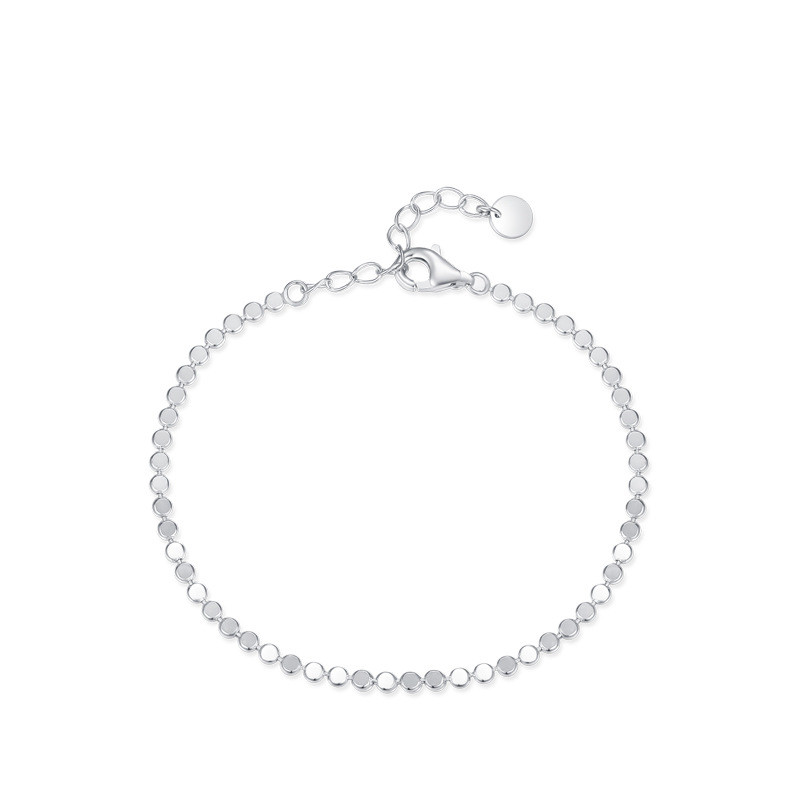
Wholesale 925 Sterling Silver Bracelet for Women | Trendy Jewelry Collection
A minimalist 925 sterling silver bracelet for women, listed for jewelry brands, retailers and wholesalers.
View productPreview only — not submitted to Tradebee. The final blog payload will use the English site language and the Sourcing & Supplier Guides blog group after approval.