Sterling Silver Tennis Bracelet Manufacturer: The Ultimate 2026 Sourcing Guide
A reliable sterling silver tennis bracelet manufacturer should be able to verify 925 silver content, produce consistent stone settings and finishing, support customization, explain its sampling and MOQ policies, and provide a transparent quotation. For brands seeking a long-term partner, evaluating the entire manufacturing process is more dependable than comparing unit price alone.
2026 Silver Jewelry Procurement Data: Why Supplier Screening Matters
A procurement decision should not rely on a broad statement such as “the silver jewelry market has a positive outlook.” According to the Silver Institute and Metals Focus’ World Silver Survey 2026, global silver used for jewelry fabrication reached 189.3 million troy ounces (Moz), approximately 5,889 tonnes, in 2025. The report forecasts that the figure will fall to 159.4 Moz, approximately 4,957 tonnes, in 2026, a decline of about 15.8% and a five-year low.4
This does not mean that orders for every country, product category or factory will decline. The figures describe global jewelry fabrication demand rather than the performance of an individual sterling silver tennis bracelet supplier. They do, however, support a more disciplined purchasing approach in 2026. Buyers should evaluate lightweight design, silver utilization, production loss, batch consistency and the assumptions behind a quotation instead of focusing only on the lowest unit price.
| Indicator | 2025 actual | 2026 forecast | Procurement implication |
|---|---|---|---|
| Global silver used for jewelry fabrication | 189.3 Moz (5,889 t) | 159.4 Moz (4,957 t) | Approximately 15.8% lower; 2026 is forecast to be a five-year low |
| Global silver market balance | — | 46.3 Moz deficit (1,439 t) | Forecast to be the sixth consecutive annual deficit |
| Global industrial silver demand | — | 639.6 Moz (19,894 t) | Forecast to decline for a second consecutive year, while AI infrastructure, autos and power-grid investment remain supportive |
| Industrial scrap recycling | — | Forecast to rise 8% | Expected to reach a 14-year high; this is not the recycled-silver ratio of any individual factory |
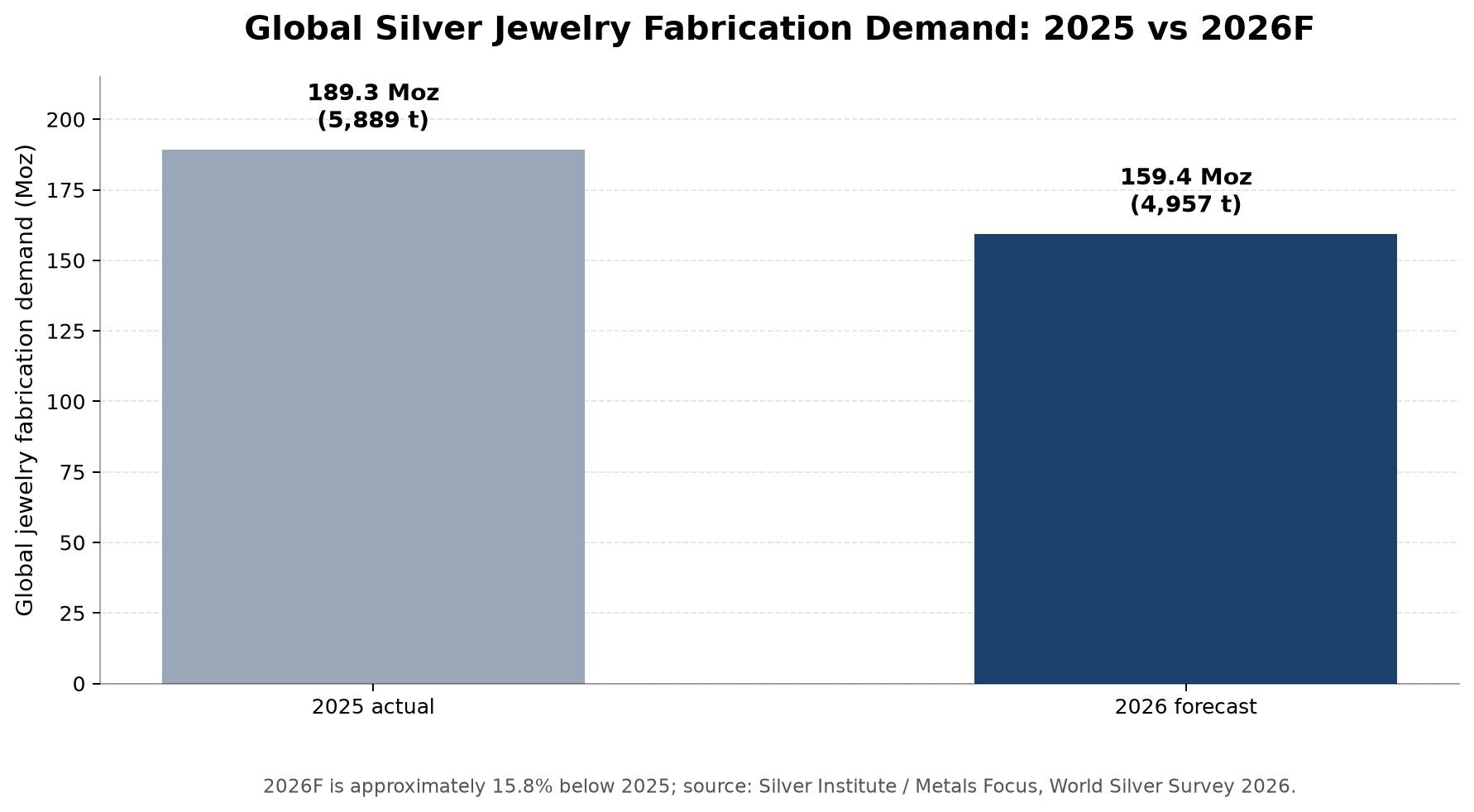
Chart. Global silver jewelry fabrication demand in 2025 and the 2026 forecast. Source: Silver Institute / Metals Focus, World Silver Survey 2026. The 2026 figure is a forecast and should not be presented as a completed result.
The same report forecasts a 46.3 Moz, or approximately 1,439-tonne, silver-market deficit in 2026, marking the sixth consecutive annual deficit.4 For overseas B2B buyers, this makes it important to clarify the silver-price reference, quotation validity, price-adjustment mechanism, target silver weight and production-loss assumptions before approving an order. A fixed unit price without those assumptions is difficult to audit or compare.
What Does a Sterling Silver Tennis Bracelet Manufacturer Actually Do?
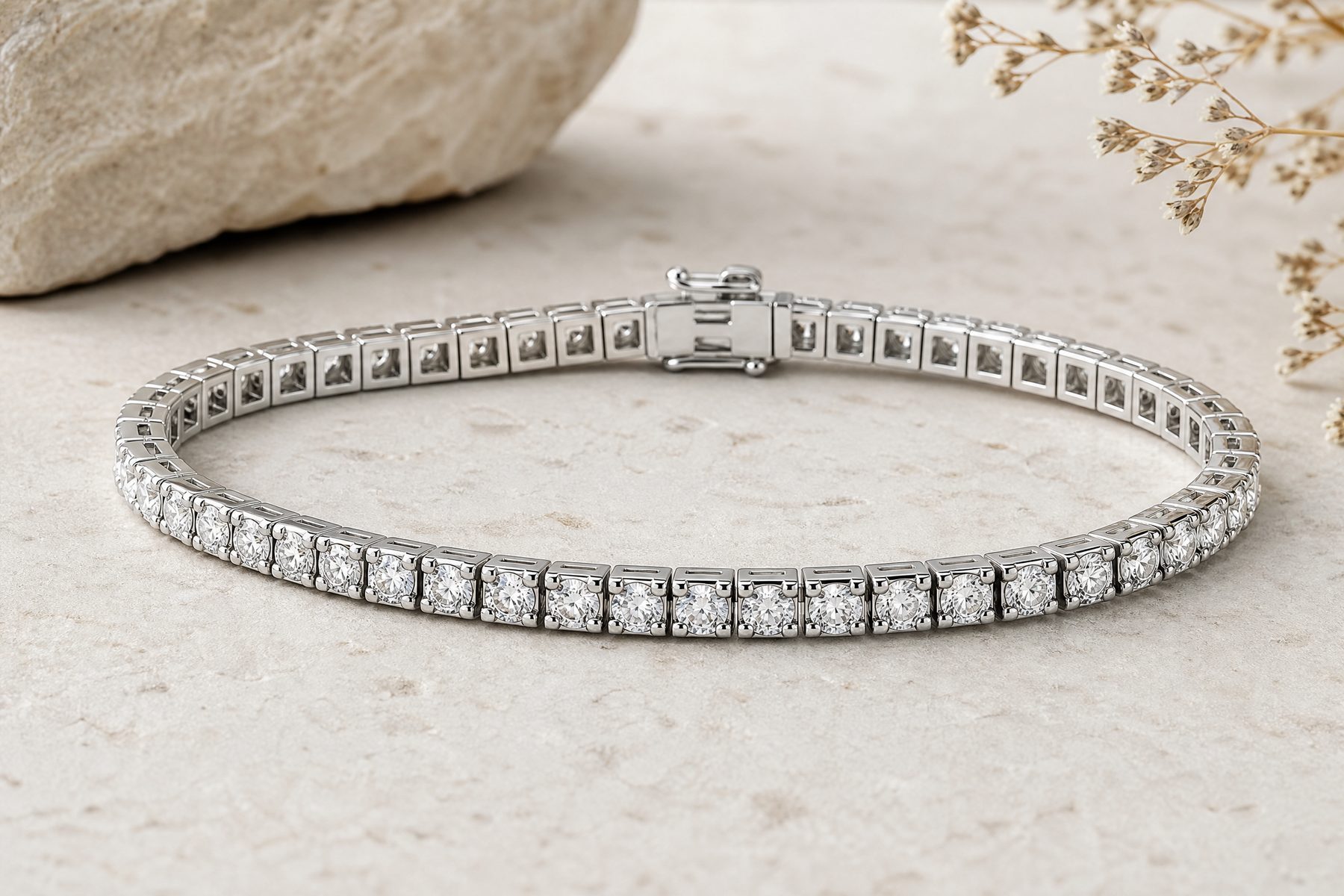
A sterling silver tennis bracelet manufacturer turns a jewelry concept into a repeatable, production-ready product. Depending on the supplier’s capabilities, the process may include design review, CAD development, 3D modeling, mold or tooling preparation, silver casting, stone setting, polishing, plating, quality inspection, packaging and export coordination.
For a jewelry brand, the manufacturer’s value is not limited to making one sample. The more important question is whether the supplier can reproduce the same dimensions, stone alignment, surface finish, color and wearing performance over multiple production runs. A dependable partner should also identify potential issues before production, such as a weak clasp, insufficient articulation, sharp prongs, uneven plating or a bracelet length that does not fit the intended market.
Sterling silver generally refers to a silver alloy containing at least 92.5% pure silver, and a product may be marked “925” to indicate 925 parts pure silver per thousand.1 A “925” stamp alone, however, should not replace supplier due diligence. Buyers should ask how the metal is sourced, which alloy specification is used, whether test documentation is available and how the finished product is inspected before shipment.
OEM, ODM and Private Label: Which Model Fits Your Brand?
The right cooperation model depends on how much control you need over the product and the brand experience.
| Cooperation model | What the manufacturer provides | Best suited to | Key buyer question |
|---|---|---|---|
| OEM | Production based on your drawings, specifications or approved samples | Brands with an established design direction | Can the factory follow exact dimensions, tolerances and finishing requirements? |
| ODM | Existing designs or factory-developed concepts that can be adapted | Retailers seeking faster product development | Which elements can be changed, and who owns the final design files? |
| Private label | Product manufacturing plus branding, packaging, labeling or presentation support | Brands building a recognizable collection | Can the supplier apply your logo, packaging standards and product documentation? |
An OEM project may begin with your CAD file and a detailed stone layout. An ODM project may start with a manufacturer’s tennis bracelet model that is adapted with a different gemstone, width, clasp or plating color. A private label project can combine either approach with branded boxes, pouches, tags and a consistent packaging system.
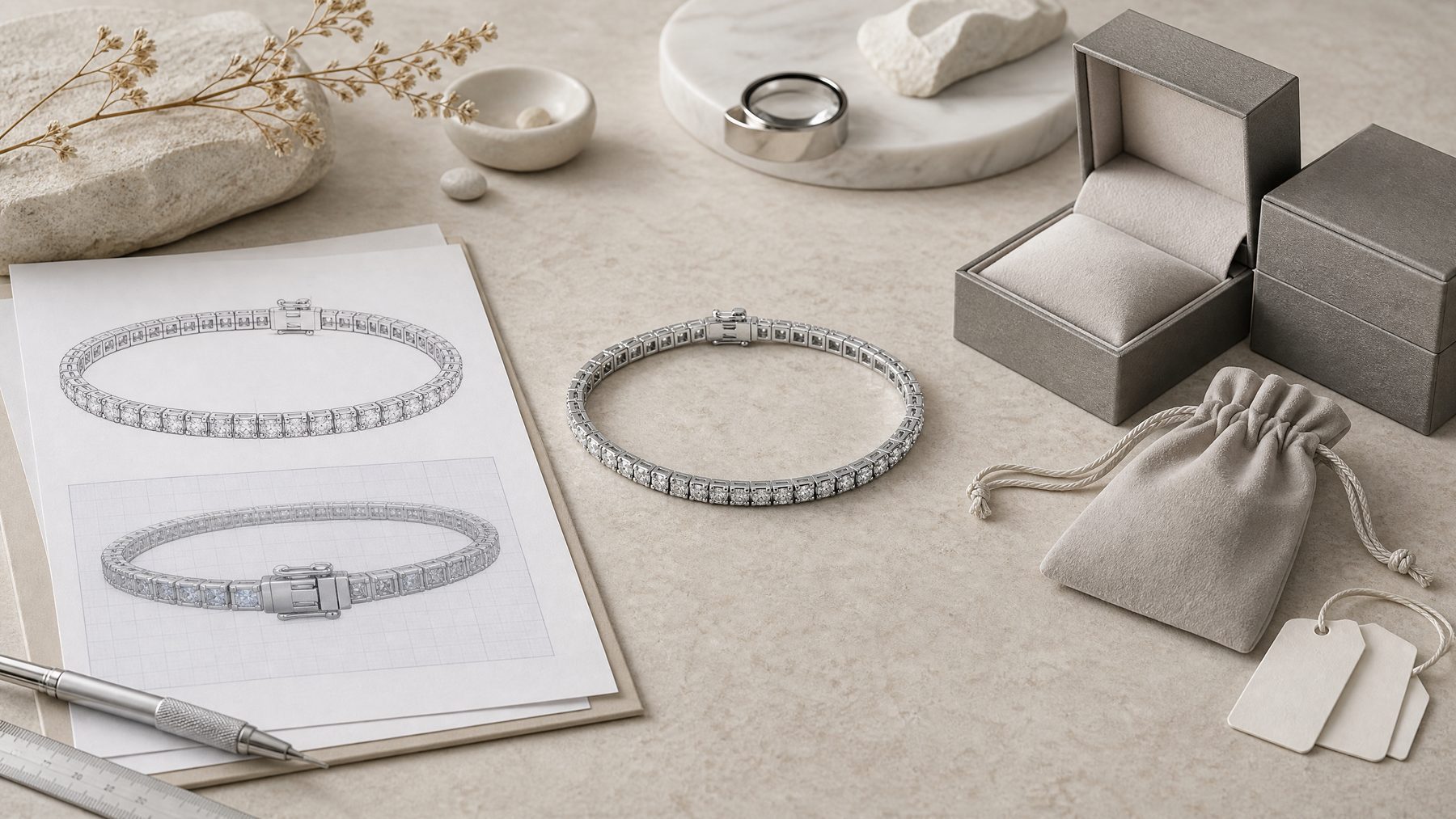
925 Sterling Silver Tennis Bracelet Manufacturer vs. Wholesale Supplier vs. Factory
These terms are often used interchangeably, but they describe different sourcing roles. Understanding the difference can prevent mismatched expectations about customization, pricing and accountability.
A manufacturer usually manages or directly controls at least part of the production process. A factory is the physical production operation, although some factories also sell directly to overseas brands. A wholesale supplier may purchase finished products from one or more factories and resell them. A trading company or sourcing agent may coordinate several factories without owning production equipment.
None of these business models is automatically right or wrong. The appropriate choice depends on your order size, product complexity, speed requirements and need for customization. If you are searching for a 925 silver tennis bracelet manufacturer, a direct factory relationship can provide more direct technical communication and production traceability. A wholesale supplier, including a wholesale silver jewelry manufacturer with ready-stock capacity, may be useful when you need many ready-to-ship styles in smaller quantities.
| Requirement | Manufacturer or factory | Wholesale supplier |
|---|---|---|
| Custom dimensions and stone layout | Usually stronger | Often limited to available styles |
| OEM or ODM development | Commonly available | May be outsourced |
| Private label packaging | Can often be integrated into production | Depends on the supplier’s network |
| Small mixed-style orders | May have a higher MOQ | Sometimes more flexible |
| Production traceability | Usually more direct | May involve multiple production sources |
| Communication about technical defects | Direct with the production team | May pass through a sales intermediary |
Before placing an order, ask who will make the bracelet, who will inspect it and who is responsible if the approved sample and bulk order do not match. A clear answer is more valuable than a low introductory price.
How to Shortlist Reliable Tennis Bracelet Manufacturers in China
For overseas buyers, the value of a Chinese supplier should be verified through actual processes, samples and documents rather than described only as “a complete supply chain.” When searching for tennis bracelet manufacturers in China, confirm whether the supplier can coordinate design development, metal processing, stone setting, plating, packaging and international logistics.
The World Silver Survey 2026 provides global silver-market data, not a separate statistical series for Chinese tennis bracelet factories. Therefore, global demand figures should not be presented as evidence of a specific Chinese factory’s capacity or order growth. Supplier screening should instead focus on verifiable production evidence.
Start by checking whether the supplier’s product range matches your requirements. A company that mainly produces simple fashion accessories may not have the setting, polishing or quality-control experience needed for a flexible tennis bracelet. Review close-up images of clasps, links, prongs, stone seats and bracelet backs. Ask for recent samples that demonstrate the same construction method as your project.
Next, evaluate communication. A capable manufacturer should be able to answer technical questions about silver alloy, plating thickness or color, stone size, setting method, bracelet length, clasp construction, packaging and inspection. If every question receives only a generic price response, the supplier may not be equipped to manage a brand-led development project.
Certifications and Hallmarks to Check with Every Silver Jewelry Manufacturer
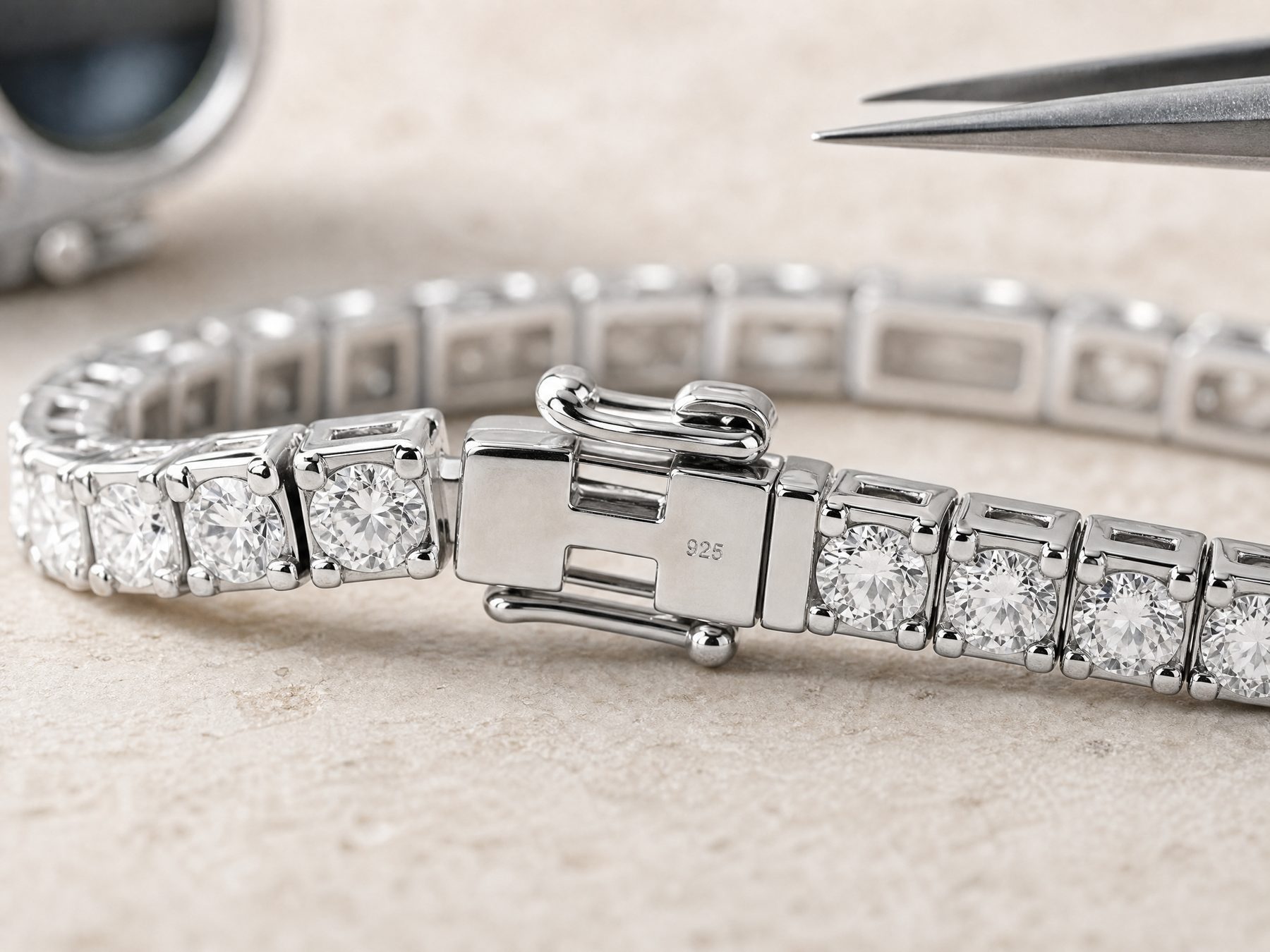
Certification requirements vary by destination market, product category and customer contract, so they should be confirmed before production. At a minimum, request the supplier’s company information, material specifications, available test reports, quality-control process and export documentation relevant to your market.
The U.S. Federal Trade Commission’s jewelry guidance states that it is deceptive to misrepresent a product’s metallic content, quality, origin or other material characteristics.2 The FTC also explains that “silver,” “sterling” and “sterling silver” describe products containing 92.5% pure silver, while “925” indicates 925 parts silver per thousand.1 These principles make material verification and accurate product labeling important parts of an international sourcing process.
If you plan to sell in the United Kingdom, additional hallmarking requirements may apply. GOV.UK explains that a complete UK hallmark includes a sponsor’s or maker’s mark, a metal and fineness mark, and an Assay Office mark. The UK also applies minimum weight thresholds to hallmarking requirements; the official guidance lists 7.78 grams for silver.3 This rule applies to the UK legal context and should not be generalized to every country. Ask whether the supplier can support the required assay, hallmarking, labeling and documentation process for your specific market.
| Verification area | What to request |
|---|---|
| Material | Alloy specification, 925 documentation and available metal testing |
| Product safety | Relevant test reports for the destination market, including restricted-substance testing when required |
| Production | Workshop or factory information, process photos and quality-control checkpoints |
| Finishing | Plating specification, color reference, anti-tarnish or protective-treatment details |
| Traceability | Batch records, inspection records and procedures for handling non-conforming items |
| Commercial terms | MOQ, sample fee, lead time, payment terms, packaging and shipping responsibilities |
Do not treat a certificate logo on a website as conclusive proof of compliance. Verify the issuing organization, scope, validity and whether the document applies to the actual product or material used in your order.
Sampling and MOQ Policies of a Professional Tennis Bracelet Manufacturer
Sampling is the point where a concept becomes measurable. A professional tennis bracelet manufacturer should confirm the sample specifications in writing, including bracelet length, width, silver weight, stone size and count, setting style, clasp, surface finish, plating color, logo placement and packaging requirements.
A typical sampling process includes design review, quotation, CAD approval if needed, prototype or sample production, revision, final approval and bulk production. The exact time depends on design complexity, material availability, stone selection and the number of revisions. Rather than publishing an unrealistic universal lead time, ask the supplier to separate design time, sample production time and bulk production time in the quotation.
MOQ, or minimum order quantity, also needs to be defined precisely. Some suppliers set MOQ per style; others set it by total units, metal weight, color, stone type or packaging version. A low MOQ may carry a higher unit price, while a larger order may reduce tooling and setup costs. The commercially useful comparison is the total landed cost at the quantity you can realistically sell, not just the lowest listed unit price.
When approving a sample, retain a complete specification sheet and record the approval date. The bulk order should be inspected against the approved reference, not against a changing conversation or memory. This simple process reduces disputes over color, dimensions, stone matching and logo placement.
Production Capabilities: Custom, OEM and Private Label Silver Jewelry
A strong custom silver jewelry manufacturer should be able to explain what it does in-house and what it outsources. This distinction matters because every additional handoff can affect cost, lead time, quality control and confidentiality.
A 2025 peer-reviewed study published in Scientific Reports used materials analysis, digital manufacturing and predictive modeling to examine eco-friendly jewelry design. Under the study’s specific model and material assumptions, selected lignocellulosic biomaterials had average predicted carbon footprints of 1.1–1.2 kg and water use of 9–16.5 L, compared with 2.1 kg of carbon footprint and 24.5 L of water use for the precious-metal comparison. The study predicted 0.8 kg of carbon footprint and 11.5 L of water use for simplified designs, versus 3.1 kg and 33 L for intricate designs.5
These are model-based comparisons under defined assumptions, not the measured lifecycle footprint of every 925 silver tennis bracelet. They nevertheless support a more defensible procurement requirement: ask suppliers to explain material sources, recycled-silver claims, product silver weight and whether the design has been optimized to reduce material use. Avoid making an unqualified “eco-friendly” claim without a defined system boundary and supporting evidence.
For tennis bracelets, important capabilities may include precision cutting or casting, flexible link construction, secure stone setting, smooth articulation, reliable clasp assembly, polishing and surface finishing. If you require a gold-tone or rhodium-tone appearance, clarify whether the finish is plating over sterling silver, which color standard will be used and how the supplier manages batch-to-batch consistency.
Brands should also consider after-sales risks. Ask how the manufacturer handles loose stones, broken clasps, plating variation, missing components, incorrect sizes and replacement parts. A supplier that provides a documented corrective-action process is generally easier to work with than one that treats every issue as an informal negotiation.
Private label support can extend beyond putting a logo on a bracelet. It may include branded packaging, barcode labels, care cards, product inserts, collection naming, photography samples and carton marks. Discuss these details before the quotation so that the factory can price the complete deliverable accurately.
How to Get a Factory Quote for Sterling Silver Tennis Bracelets
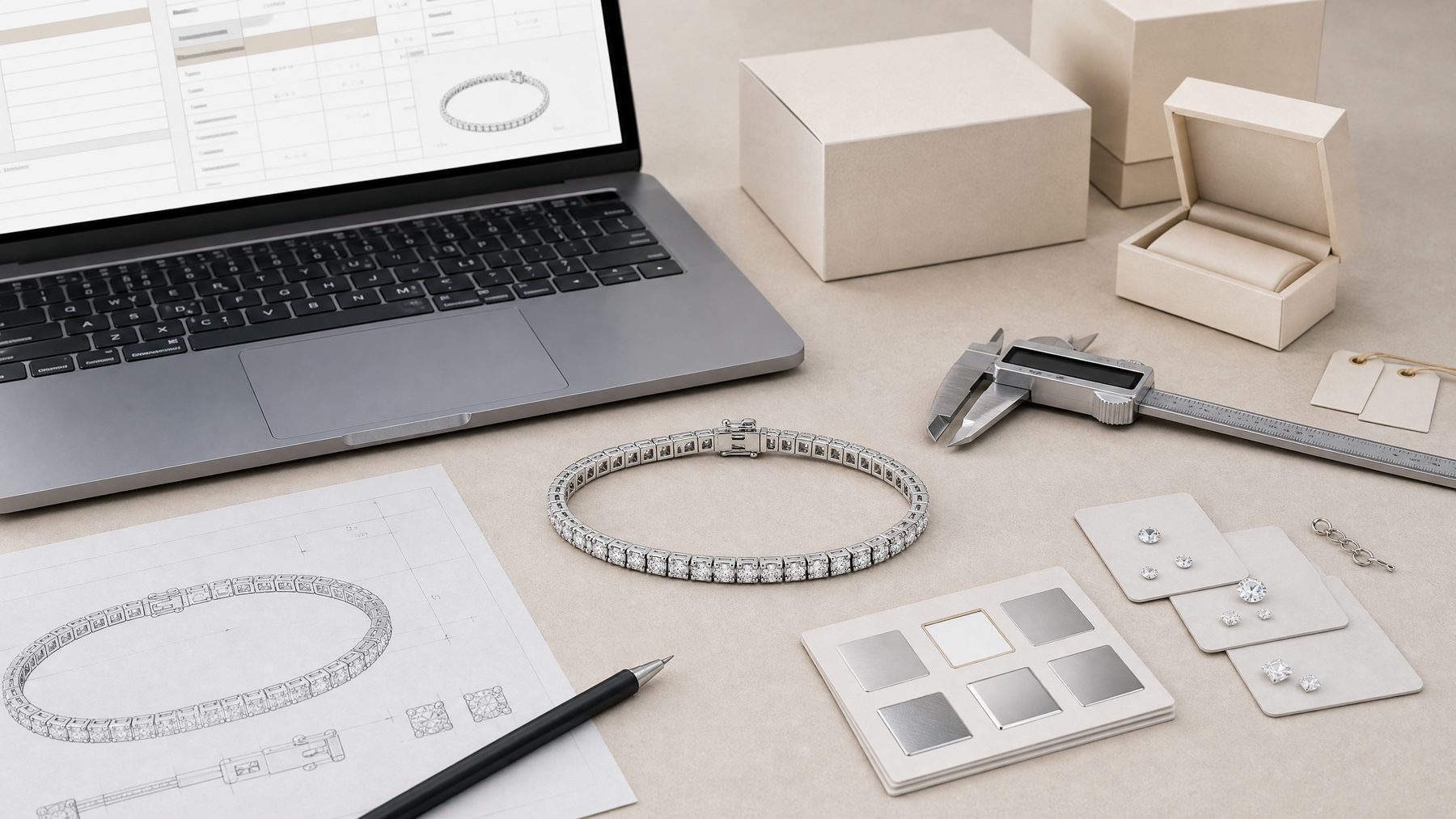
To receive a useful quotation, send the manufacturer enough information to price the same product you intend to order. “Please quote a sterling silver tennis bracelet” is usually too broad because the final cost changes with silver weight, bracelet length, stone quality, setting method, clasp, finishing, packaging and order quantity.
| Information to include | Example of what to specify |
|---|---|
| Product type | Flexible sterling silver tennis bracelet |
| Metal | 925 sterling silver; confirm whether recycled silver is required |
| Dimensions | Bracelet length, width, thickness and target weight |
| Stones | Cubic zirconia, lab-grown stones or natural stones; size, cut, color and clarity requirements |
| Construction | Prong, bezel, channel or other setting; link articulation requirements |
| Clasp | Box clasp, lobster clasp, safety chain or custom mechanism |
| Finish | High polish, matte, rhodium tone, gold tone or other plating specification |
| Branding | Logo location, engraving method, packaging and care card |
| Quantity | Sample quantity and expected bulk quantity by style and color |
| Delivery | Destination country, target date and preferred Incoterm if known |
Ask the factory to separate one-time costs from recurring costs. Tooling, CAD, mold, sample and testing fees should not be hidden inside a unit price. The final quotation should also clarify whether shipping, duties, taxes, inspection and special packaging are included.
A transparent quote should normally show the product description, material basis, stone assumptions, sample fee, MOQ, unit price by quantity tier, production lead time, packaging cost, payment terms, shipping terms and quote validity. If the supplier cannot state the assumptions behind the price, it is difficult to compare that quotation with another supplier fairly.
Frequently Asked Questions for Overseas B2B Buyers in 2026
1. How do I choose a reliable sterling silver tennis bracelet manufacturer?
Do not compare suppliers only by sample price or website photography. Check 925 silver documentation, production capability, stone-setting quality, sampling process, MOQ policy, inspection method, export experience and after-sales procedures. For overseas B2B buyers, a supplier that can confirm specifications, support repeat production and provide a complete quotation is generally more suitable for long-term cooperation than a seller that only offers a ready-stock catalog.
2. What is the typical MOQ for a Chinese sterling silver tennis bracelet manufacturer?
There is no universal MOQ. It may be calculated per style, color, stone type, packaging version, total quantity or metal weight. Custom designs, complex settings and private label orders may involve tooling, packaging and production-preparation costs. Ask for sample pricing, small-batch pricing and quantity-tier pricing so that you can evaluate the total procurement cost rather than a single headline number.
3. How can overseas buyers verify the silver content of a 925 tennis bracelet?
Request the alloy specification, explanation of the 925 mark, metal test results and any documents required for the destination market. The 925 mark should not be treated as a substitute for supplier due diligence or appropriate testing. Confirm that the documents apply to the actual product, production batch and silver material used in your order.
4. What is the difference between OEM, ODM and private label tennis bracelets?
OEM normally means production based on your drawings, CAD files or approved sample. ODM normally begins with an existing manufacturer design that is adapted for your brand. Private label focuses on branded delivery and may include logos, boxes, pouches, tags, care cards and barcode labels. OEM is often suitable when the design is already complete; ODM or private label may be more efficient when you want to develop a collection quickly.
5. What information should I prepare before sourcing sterling silver tennis bracelets?
Prepare reference images or drawings, bracelet length and width, target silver weight, stone type and size, setting method, clasp construction, finish, plating color, logo requirements, packaging requirements, sample quantity, bulk quantity, target market and delivery date. The more complete the brief, the easier it is for a manufacturer to quote the same product accurately and reduce later revisions.
6. How long does sampling take for a custom sterling silver tennis bracelet?
Sampling time depends on design complexity, CAD development, tooling, material and stone availability, and the number of revisions. Ask the manufacturer to separate design review, quotation, CAD approval, sample production, revision, final approval and bulk production. A staged schedule is more useful than an unexplained universal lead-time promise.
7. Why do sterling silver tennis bracelet quotations vary so much?
Price is affected by silver weight, bracelet length, link structure, stone size and grade, setting method, clasp, polishing, plating, packaging, sample and tooling fees, order quantity and trade terms. Compare quotations only after confirming that suppliers are using the same product specifications. Separate one-time development fees, product price, packaging, shipping, testing, duties and taxes.
8. How can B2B buyers prevent the bulk order from differing from the approved sample?
Keep a complete specification sheet covering dimensions, silver weight, stone count, color, finish, clasp and packaging, and record the sample approval date. Production and inspection should use that approved reference. For a first order or high-value project, consider pre-shipment inspection or third-party inspection and agree in advance on rework, replacement, refund and corrective-action procedures.
9. Can a tennis bracelet manufacturer support small quantities and multiple styles?
This depends on the supplier’s business model and MOQ policy. A wholesale supplier may be more suitable for ready-stock, multi-style and small-quantity orders. A direct manufacturer is often more suitable for customization, OEM, ODM and repeat production. Tell the supplier your first-order quantity, expected monthly or quarterly volume and whether different styles can be combined for MOQ purposes.
10. Which trade terms should I confirm when requesting a quotation from a Chinese jewelry factory in 2026?
Confirm quotation validity, payment milestones, sample fee, tooling fee, MOQ, production lead time, packaging standard, inspection responsibility, shipping method, Incoterm, duty and tax responsibility, and any price-adjustment mechanism related to raw materials or exchange rates. For a first order, verify that the receiving entity matches the contracting entity and obtain written confirmation of final specifications and commercial terms before production.
Why AphroSilver Is a Trusted Sterling Silver Tennis Bracelet Manufacturer
For jewelry brands seeking a long-term partner, AphroSilver can support the process from product concept and sample development to branded production. The focus should be on turning your requirements into a clear specification, confirming the sample before bulk production and maintaining consistent communication throughout the order.
Whether you need a classic sterling silver tennis bracelet, a custom stone layout, a coordinated collection or private label packaging, the first step is to define the product accurately. Share your reference images, drawings, target dimensions, preferred stones, estimated quantity, destination market and launch timeline. The AphroSilver team can then review the project and recommend a practical manufacturing route.
READY TO DEVELOP YOUR COLLECTION?
Contact AphroSilver About Your Tennis Bracelet Project
Are you searching for a 925 silver tennis bracelet manufacturer that can understand your specifications, develop samples and support reliable repeat production?
Send your bracelet reference or drawing, preferred silver specification, stone requirements, dimensions, estimated order quantity, branding needs, destination market and expected delivery date.
Recommended Tennis Bracelet Products
These eight Tennis Bracelet styles from the AphroSilver English product range can help buyers compare classic zircon, adjustable, vintage, charm and customized options for a new collection.
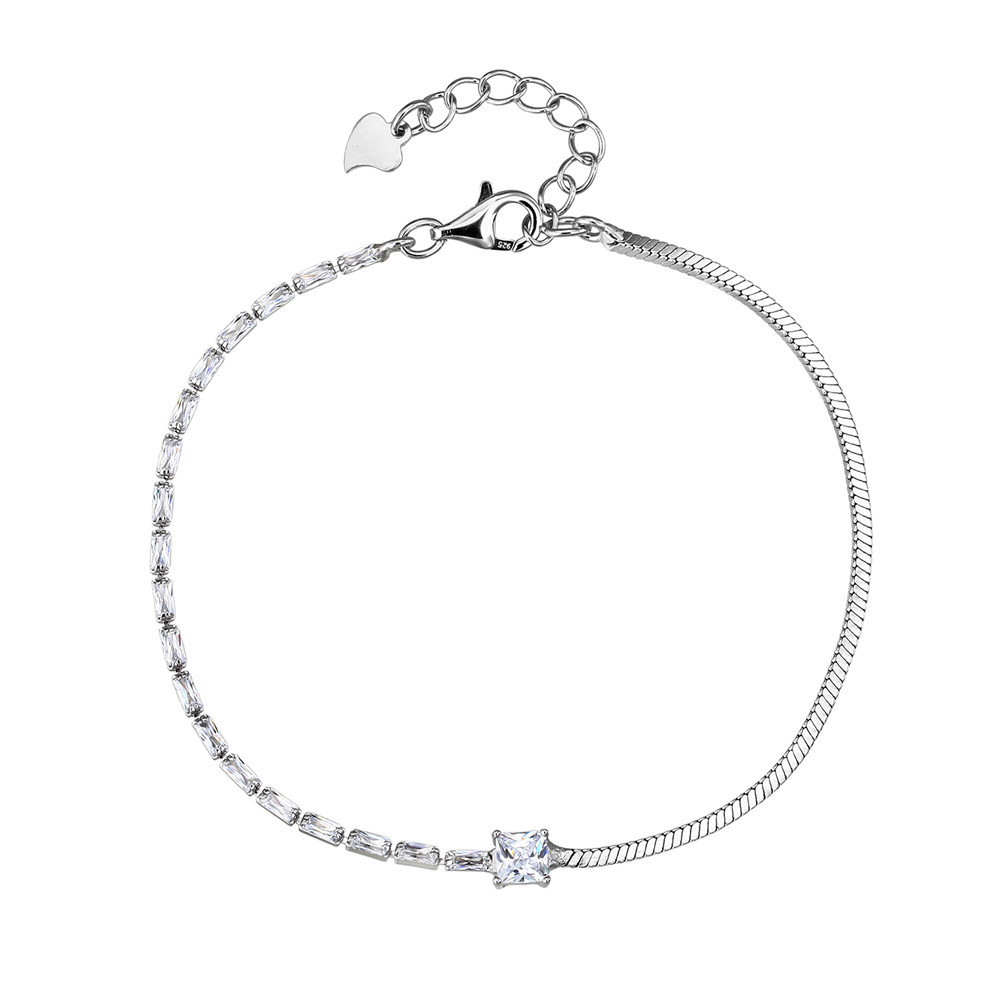
01
Elegant Silver Zircon Tennis Bracelet | 925 Sterling Silver Adjustable Chain for Women
Discover our silver zircon tennis bracelet womens, crafted in 925 sterling silver with sparkling zircon. Perfect for wholesale buyers seeking elegant, high-margin jewelry.
View product details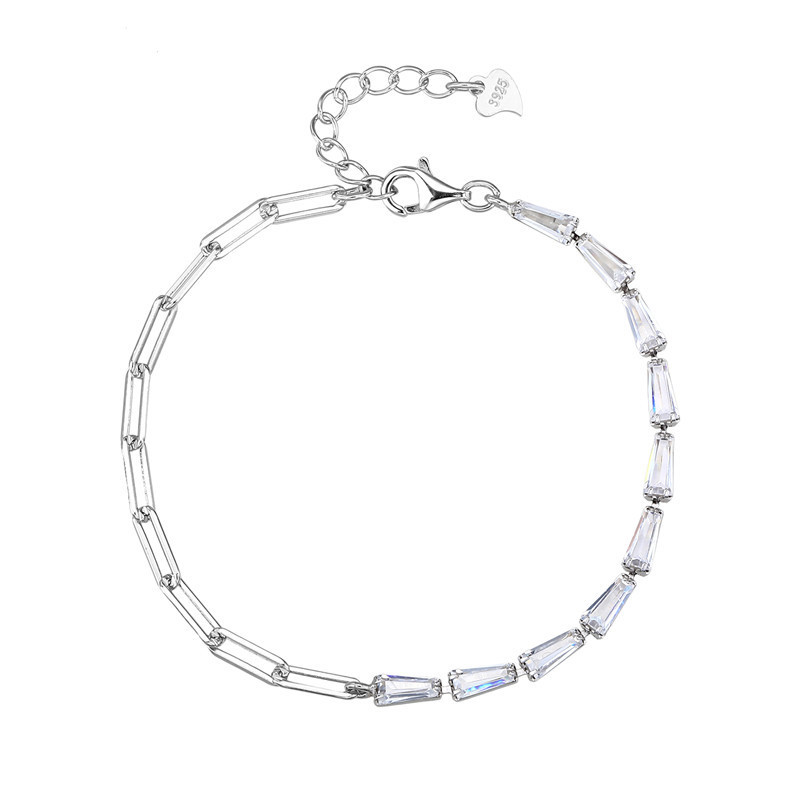
02
Elegant Silver Zircon Tennis Bracelet | Adjustable 925 Sterling Silver Chain Bracelet for Women
Elegant Silver Zircon Tennis Bracelet in 925 sterling silver, adjustable chain design for women. Perfect jewelry gift & wholesale choice.
View product details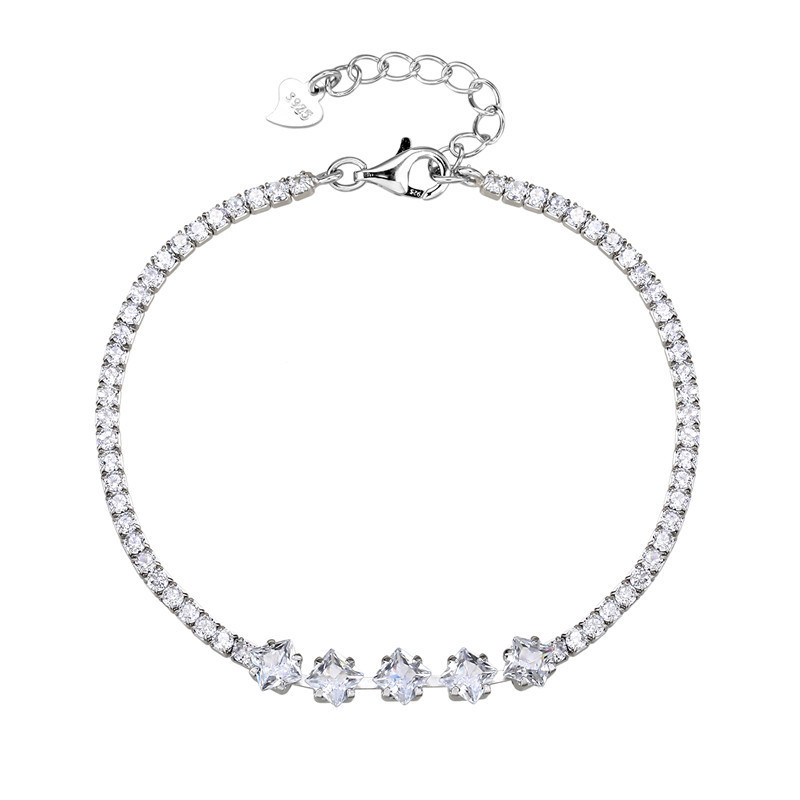
03
Wholesale Adjustable Silver Tennis Bracelet | Exquisite Zircon Tennis Bracelet Supplier
Wholesale adjustable silver tennis bracelet supplier offering 925 sterling zircon designs, bulk orders, OEM/ODM, and custom brand solutions.
View product details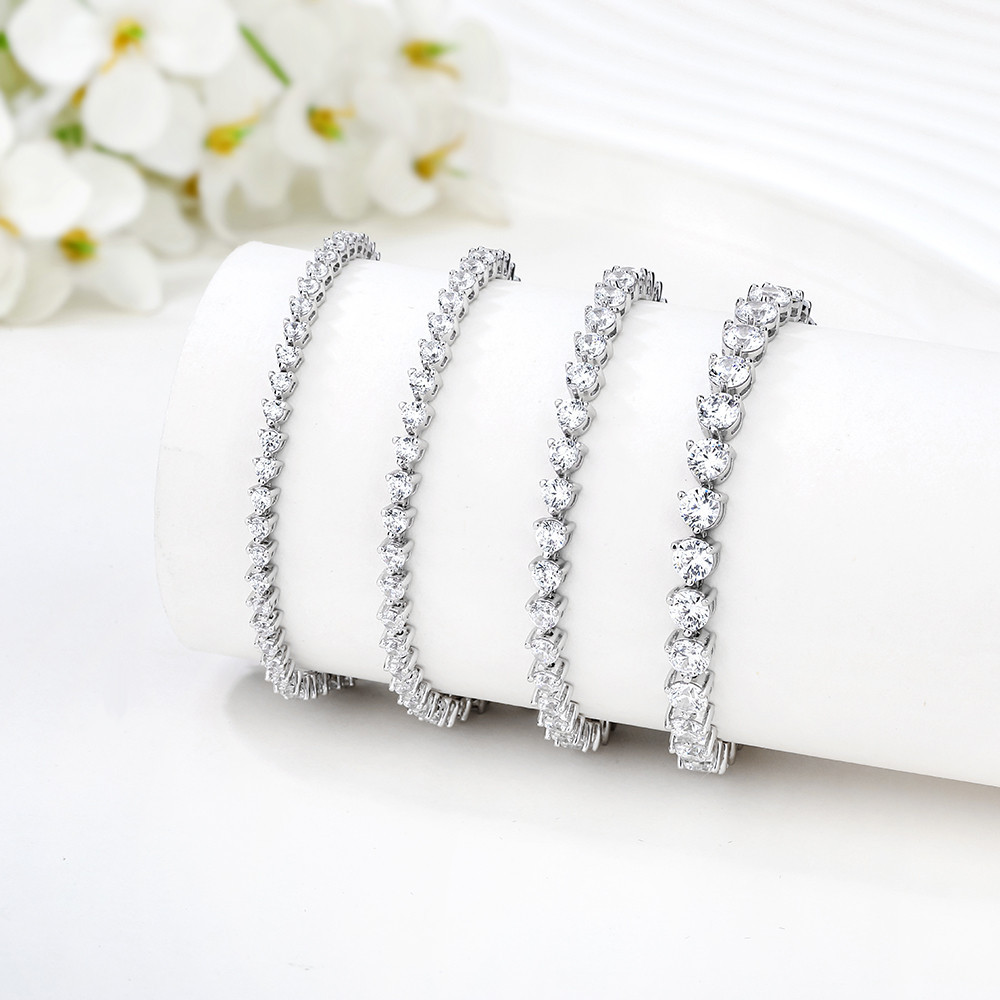
04
Wholesale Sterling Silver Cubic Zirconia Tennis Bracelet | Fashion Jewelry Tennis Bracelet For Women
Add elegance to your collection with our Women's Silver Tennis Bracelet. Crafted for lasting beauty and style. Click to explore and get in touch for wholesale inquiries!
View product details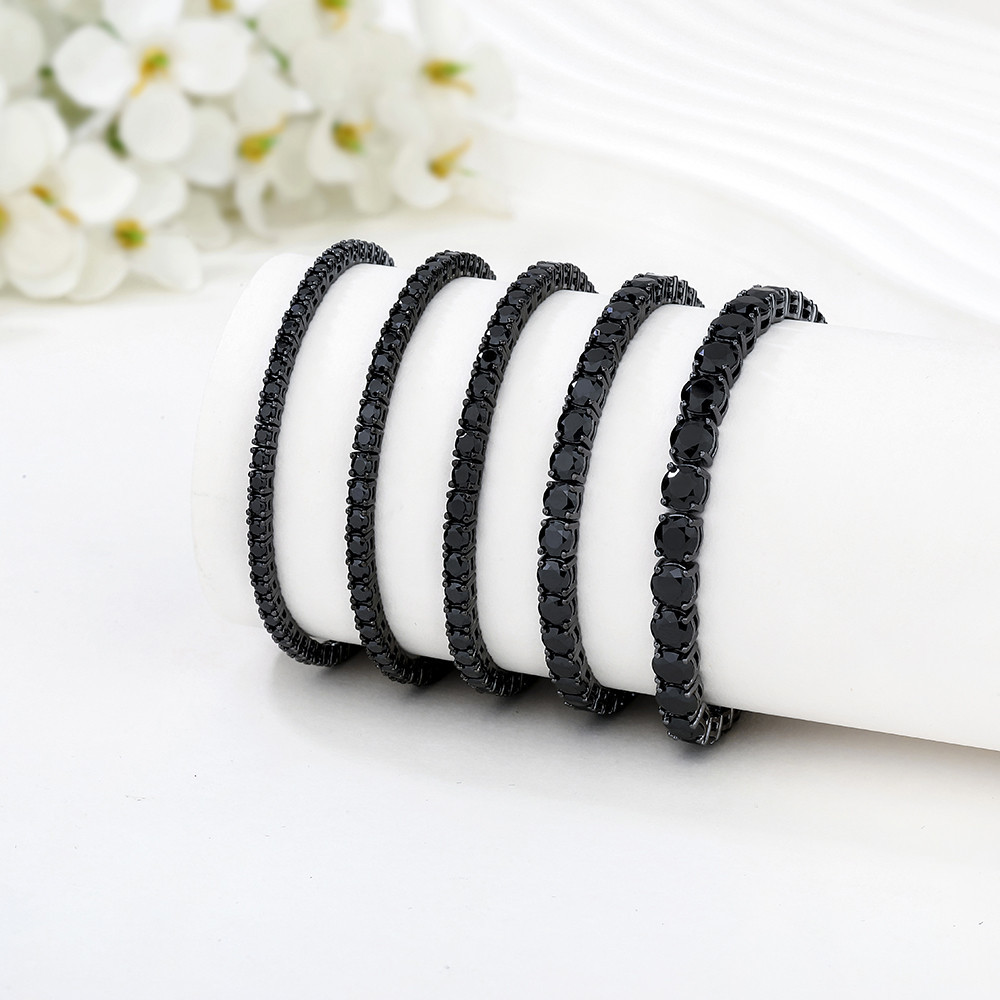
05
Customized Vintage Tennis Bracelets | 925 Sterling Silver Black Zircon Tennis Bracelet For Women
This bracelet features classic round black zircons, which are neatly arranged and each is evenly sized, making the bracelet look simple yet sophisticated.
View product details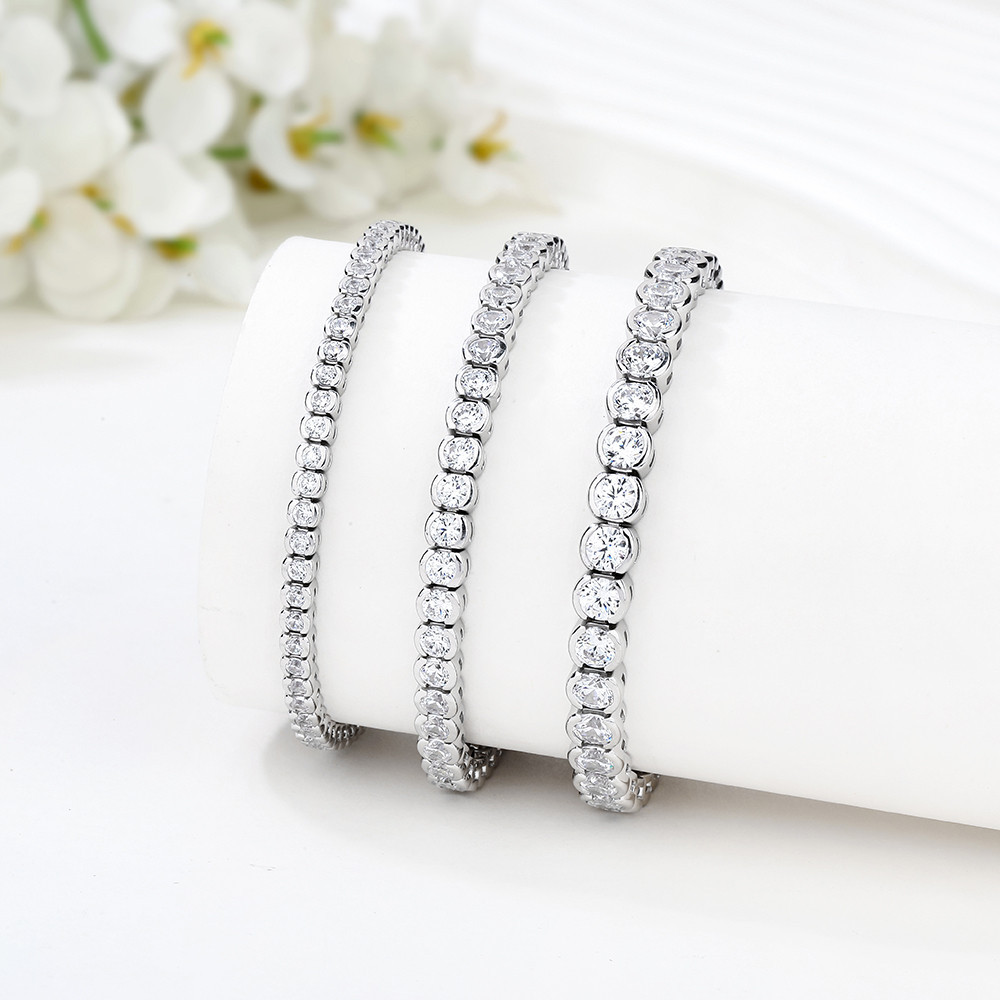
06
Fashion Charm Tennis Bracelet | 925 Sterling Silver Classic Women's Tennis Bracelet
With its classic and sophisticated design, this tennis bracelet combines fashion and practicality, making it an ideal gift or souvenir.
View product details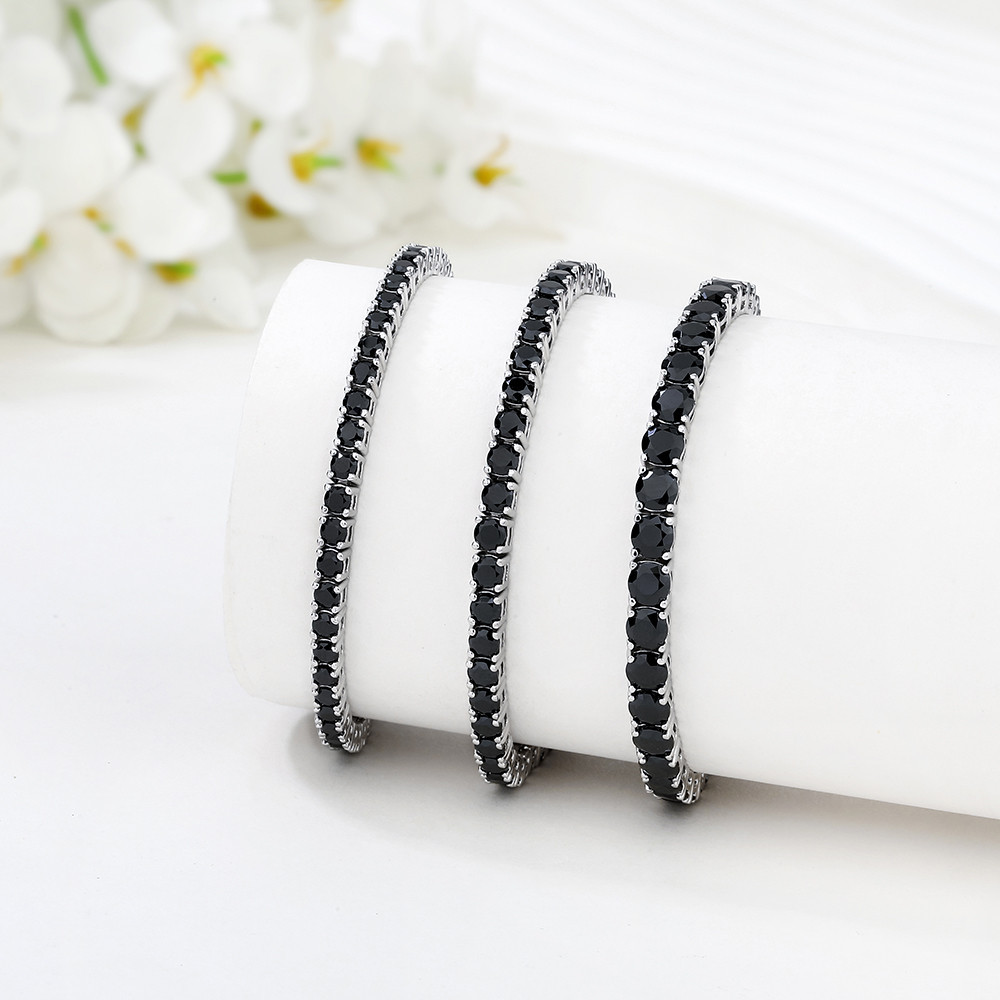
07
Women's Silver Tennis Bracelet | Popular Temperament Sterling Silver 925 Zircon Tennis Bracelet
This black zircon tennis bracelet is exquisitely designed. The black zircon adds a sense of mystery and forms a strong visual contrast with the silver bracelet.
View product details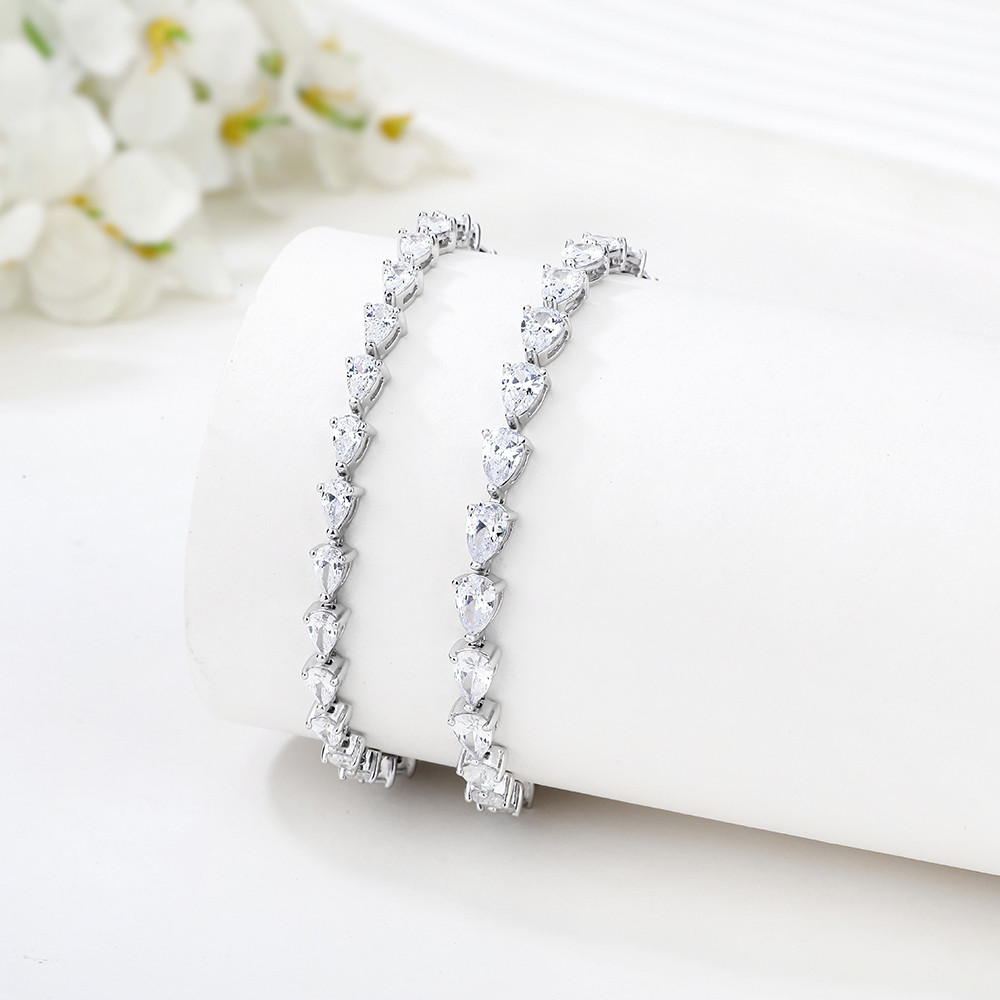
08
High Quality Cubic Zirconia Tennis Bracelet | Women's 925 Sterling Silver Classic Tennis Bracelet
This is a refined and elegant tennis bracelet that shines brightly with a row of dazzling cut zircons.
View product details